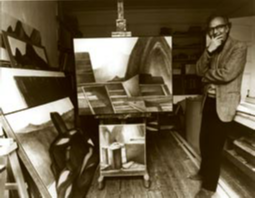


I was born in La Paz, Bolivia in 1930. My father, Hugo Montes, was a prominent lawyer and member of a family who had played a major role in the political life of the country from the late nineteenth century. At the time of his death my father was the leader of the Liberal Party in Bolivia. He married Eloisa Peñaranda Minchin and I was the third child.
La Paz is a city that nestles in a valley at 3600 metres above sea level. As a child, I remember seeing the extraordinary light of the high altitude and also the intense sky, as deep as an ocean, where in winter you can see Venus, even during the day. La Paz is surrounded by mountains; from the city on one side you can see, high up, the long rim of the High Plateau that leads to Lake Titicaca and, beyond it, to Peru. On the other side, the great snow covered Illimani towers above the city. The High Andes have magnificent snow peaks, some of them more than 6000 metres high.
One of the extraordinary experiences in my childhood was to go to Argentina by train. Then, as a little boy, I saw from the carriage window the strange and fantastic landscapes of the High Plateau, which we call the Altiplano, and also the Salar de Uyuni, a vast salt lake which stretches to the horizon like a sea of white. The train went through desolate areas of South America and climbed gradients, reaching an icy 5000 metres above sea level, to descend eventually to the mild climate of green valleys that were a delight to see. My child’s eyes experienced this magnificent geography at a very early age.
When I was 7 years old my father was killed in a car accident. We first went to live with my maternal grandmother, Sarah Minchin. Then, in 1942 we went as a family to live in Buenos Aires and there in the big city, which was at that time the most important cultural centre in South America, I began to study painting.
Aged 15, I tried to gain admission to the studio of Vicente Puig. I was told to return when I was 18, but I wanted to start immediately. My grandmother who was the relative who most encouraged my artistic vocation, went to speak to the master. He said that, because there was a nude model in the life class, they did not like to accept very young students. At that time Argentina was a very traditional society. My grandmother with a surprisingly liberal mind assured him that I had her permission and I was accepted.
I was lucky to study under Vicente Puig. He was a famous teacher in Buenos Aires. He was an exile from the Spanish Civil War, a contemporary of the great composer, Manuel de Falla, Jacinto Benavente and Margarita Xirgu; all had taken refuge in Argentina. Puig was a brilliant teacher and all his comments although sometimes cruel were of great depth, simple and intensely expressive, often with a metaphysical meaning. He revealed to me the importance and excellence of drawing and an understanding of the human figure: ‘a human head is a miracle’. With the years and maturity, I learned to appreciate even more his comments: ‘Master and student are on the same level in front of Nature’ ‘Art is an adventure’; ‘If you stab, stab to kill’, by which he meant that one had to be deliberate in the way one made marks on the paper.
When I finished school in Buenos Aires, I returned to the High Andes to study philosophy at the University of San Andres in La Paz. In 1951 I joined a group of film makers. Jorge Ruiz, a childhood friend and Augusto Roca who were pioneers of the film industry in Bolivia. We journeyed to remote parts of the Altiplano and descended to the rain forest to 300 meters above sea level, where the Moseten tribe of indians lives. From the drawings I made during this trip I worked a series of paintings about this people.
After two years working in films, I took up painting professionally. I painted portraits, nudes and landscapes of the mountains and valleys around La Paz .
My first exhibition was in the Municipal Gallery in La Paz, at the time the only permanent gallery in the city. In this exhibition I showed portraits. Soon afterwards, I represented Bolivia at the 5th Sâo Paulo Biennial, Brazil.
At the same time the Spanish Government awarded me a scholarship to study at the Royal Academy of San Fernando in Madrid. It was quite an experience to have classes in this old and historic building, where Goya had studied. Now it is an art museum that includes in its collection a good number of excellent works by Goya There I met students with extraordinary talent. At that time San Fernando was a classical academy which offered a very rigorous training. It seems to have produced, perhaps by reaction, some of the most revolutionary artists. In Madrid I would go to the Prado Museum almost every day to see the magnificent collection, particularly of Spanish masters. In Spain I discovered the use of white as a colour.
When I finished my studies, in 1960, I came to London. Marcela Villegas Sanchez Bustamante, whom I had known from Bolivia, was at that time living in London. She became my wife six months later. We settled in London, during the Belle Epoch of the sixties, and I had my first one man exhibition outside Bolivia. The paintings were portraits, London cityscapes and paintings of people in London pubs. The pub paintings were a way of exploring inner London and human relationships in this environment. They gave me the chance to use the human figure, which has always fascinated me.
In 1965 we visited Bolivia with our son, Juan Enrique who was by then three years old. On this visit I was dazzled by the intense white light of the high altitude and again encountered the magnificent landscape of my childhood. On seeing the High Andes with the eyes of a mature person I found myself as an artist. The luminosity of the altitude and the cosmic landscape surrounded by snow covered mountains, reminded me of Von Keyserling’s comment when he arrived to La Paz and said that it was “the third day of creation “. I realised how fitting his reaction to the Andes was.
Within a year, I started to work on a series of paintings on the landscape of the Altiplano and its people, exploring the relationship between the Indians and the Altiplano. Previously my landscapes had depicted specific locations; now my work focused on the essence of the relationship between the human being and the land. During this period, in 1966, our daughter, Sarita, was born.
My work was recognised in 1973, when I was invited to participate in an exhibition entitled ‘Bolivian Contemporary Painters’ at the Museum of Modern Art in Paris. One of my paintings, ‘Women and Land’, was chosen to illustrate the poster. It was a moving experience for me to see a reproduction of my work all over Paris.
When Toynbee’s work ‘Mankind and Mother Earth’ was published, the title intrigued me. I read the work and was very impressed by the last two chapters, which are called ‘Biosphere’. Without realising it, I had been concerned with this theme, not only in my painting, but even in my early work in films. There is no doubt that you experience the spirit of the Earth in Bolivia. Amongst the Indian population this is very alive. Mother Earth is worshipped as Pachamama.
I was invited to exhibit in Japan in 1982. This invitation was an important experience, not only for my painting, but also for my understanding of the origins of the indigenous people of America. It was a marvellous encounter with a highly refined culture. I was surprised to find that there is a module of aesthetics that the Japanese call ”shibui”. This is the view of beauty that consists of four characteristics: tranquillity, simplicity, space and silence. It is a spiritual quality in art that comes from Zen Buddhism. When I saw the Japanese Temple of Horyuji, said to be the oldest wooden structure in the world and the oldest Buddhist temple in Japan, I was overwhelmed by its beauty. This aesthetic experience was exactly the feeling I was seeking in my painting. What a great encounter it was! I came to like Japan and its people enormously.
In 1987, after devoting my painting to the High Andes for many years and exploring the human figure and the land, I decided to travel overland from Peru to Bolivia. It was on this journey that I saw Machu Picchu for the first time. It was an overwhelming experience. The ruins lay in extraordinary harmony with the spectacular surrounding landscape, like a jewel perfectly set in a ring. This feeling gave me a big impetus to work. I stayed there for a period of time and returned to London with thirty drawings. They became the seeds of many paintings on this subject.
The first time I exhibited them was in Tokyo and, soon afterwards, I exhibited the drawings in London. In this exhibition, an English architect, who was developing an ecological approach to architecture, asked me for a reproduction of one of my drawings to illustrate an article of his on this subject. According to him Machu Picchu was a perfect example of ecological architecture. I worked on this subject for five years.
The paintings inspired by Machu Picchu, along with the figures and landscapes, were exhibited four times in Italy: in Venice, Florence, Rapallo and Rome. As most artists in the past and present, I was bewitched by this marvellous country and its people and I was very moved when they made me a fellow of the Archaeological Academy of Rome.
In 1993 I presented a painting of Machu Picchu called ‘Gate to Silence’ to the National Museum in La Paz, Bolivia. My nephew, Fernando Montes Ruiz, who is an anthropologist and a very spiritual person, saw this work and told me that he knew where the next step in my painting lay. Soon after, we travelled to the Island of the Sun in Lake Titicaca. We went to this island as pilgrims and followed the old Inca road, making offerings at each station on the way until we got to the sacred rock. This is one of the most sacred places in the Andes. It has been worshipped since before Inca times up to present times. This pilgrimage was a magnificent encounter with the Sacred Andes and, as with Machu Picchu, I returned to London with 30 drawings that have become the basis of my recent work. This work was exhibited in Paris in 1996 with the title ‘Les Andes Sacrées’. The exhibition gave me profound satisfaction when I realised how well it was received in that important cultural centre of the world.
It has been a privilege for me to take the spirit of the high Andes to the great centres of the world and to convey my experience to different cultures. This has been a great reward to my effort and struggle with my painting.
Fernando Montes
May 1999
La Paz is a city that nestles in a valley at 3600 metres above sea level. As a child, I remember seeing the extraordinary light of the high altitude and also the intense sky, as deep as an ocean, where in winter you can see Venus, even during the day. La Paz is surrounded by mountains; from the city on one side you can see, high up, the long rim of the High Plateau that leads to Lake Titicaca and, beyond it, to Peru. On the other side, the great snow covered Illimani towers above the city. The High Andes have magnificent snow peaks, some of them more than 6000 metres high.
One of the extraordinary experiences in my childhood was to go to Argentina by train. Then, as a little boy, I saw from the carriage window the strange and fantastic landscapes of the High Plateau, which we call the Altiplano, and also the Salar de Uyuni, a vast salt lake which stretches to the horizon like a sea of white. The train went through desolate areas of South America and climbed gradients, reaching an icy 5000 metres above sea level, to descend eventually to the mild climate of green valleys that were a delight to see. My child’s eyes experienced this magnificent geography at a very early age.
When I was 7 years old my father was killed in a car accident. We first went to live with my maternal grandmother, Sarah Minchin. Then, in 1942 we went as a family to live in Buenos Aires and there in the big city, which was at that time the most important cultural centre in South America, I began to study painting.
Aged 15, I tried to gain admission to the studio of Vicente Puig. I was told to return when I was 18, but I wanted to start immediately. My grandmother who was the relative who most encouraged my artistic vocation, went to speak to the master. He said that, because there was a nude model in the life class, they did not like to accept very young students. At that time Argentina was a very traditional society. My grandmother with a surprisingly liberal mind assured him that I had her permission and I was accepted.
I was lucky to study under Vicente Puig. He was a famous teacher in Buenos Aires. He was an exile from the Spanish Civil War, a contemporary of the great composer, Manuel de Falla, Jacinto Benavente and Margarita Xirgu; all had taken refuge in Argentina. Puig was a brilliant teacher and all his comments although sometimes cruel were of great depth, simple and intensely expressive, often with a metaphysical meaning. He revealed to me the importance and excellence of drawing and an understanding of the human figure: ‘a human head is a miracle’. With the years and maturity, I learned to appreciate even more his comments: ‘Master and student are on the same level in front of Nature’ ‘Art is an adventure’; ‘If you stab, stab to kill’, by which he meant that one had to be deliberate in the way one made marks on the paper.
When I finished school in Buenos Aires, I returned to the High Andes to study philosophy at the University of San Andres in La Paz. In 1951 I joined a group of film makers. Jorge Ruiz, a childhood friend and Augusto Roca who were pioneers of the film industry in Bolivia. We journeyed to remote parts of the Altiplano and descended to the rain forest to 300 meters above sea level, where the Moseten tribe of indians lives. From the drawings I made during this trip I worked a series of paintings about this people.
After two years working in films, I took up painting professionally. I painted portraits, nudes and landscapes of the mountains and valleys around La Paz .
My first exhibition was in the Municipal Gallery in La Paz, at the time the only permanent gallery in the city. In this exhibition I showed portraits. Soon afterwards, I represented Bolivia at the 5th Sâo Paulo Biennial, Brazil.
At the same time the Spanish Government awarded me a scholarship to study at the Royal Academy of San Fernando in Madrid. It was quite an experience to have classes in this old and historic building, where Goya had studied. Now it is an art museum that includes in its collection a good number of excellent works by Goya There I met students with extraordinary talent. At that time San Fernando was a classical academy which offered a very rigorous training. It seems to have produced, perhaps by reaction, some of the most revolutionary artists. In Madrid I would go to the Prado Museum almost every day to see the magnificent collection, particularly of Spanish masters. In Spain I discovered the use of white as a colour.
When I finished my studies, in 1960, I came to London. Marcela Villegas Sanchez Bustamante, whom I had known from Bolivia, was at that time living in London. She became my wife six months later. We settled in London, during the Belle Epoch of the sixties, and I had my first one man exhibition outside Bolivia. The paintings were portraits, London cityscapes and paintings of people in London pubs. The pub paintings were a way of exploring inner London and human relationships in this environment. They gave me the chance to use the human figure, which has always fascinated me.
In 1965 we visited Bolivia with our son, Juan Enrique who was by then three years old. On this visit I was dazzled by the intense white light of the high altitude and again encountered the magnificent landscape of my childhood. On seeing the High Andes with the eyes of a mature person I found myself as an artist. The luminosity of the altitude and the cosmic landscape surrounded by snow covered mountains, reminded me of Von Keyserling’s comment when he arrived to La Paz and said that it was “the third day of creation “. I realised how fitting his reaction to the Andes was.
Within a year, I started to work on a series of paintings on the landscape of the Altiplano and its people, exploring the relationship between the Indians and the Altiplano. Previously my landscapes had depicted specific locations; now my work focused on the essence of the relationship between the human being and the land. During this period, in 1966, our daughter, Sarita, was born.
My work was recognised in 1973, when I was invited to participate in an exhibition entitled ‘Bolivian Contemporary Painters’ at the Museum of Modern Art in Paris. One of my paintings, ‘Women and Land’, was chosen to illustrate the poster. It was a moving experience for me to see a reproduction of my work all over Paris.
When Toynbee’s work ‘Mankind and Mother Earth’ was published, the title intrigued me. I read the work and was very impressed by the last two chapters, which are called ‘Biosphere’. Without realising it, I had been concerned with this theme, not only in my painting, but even in my early work in films. There is no doubt that you experience the spirit of the Earth in Bolivia. Amongst the Indian population this is very alive. Mother Earth is worshipped as Pachamama.
I was invited to exhibit in Japan in 1982. This invitation was an important experience, not only for my painting, but also for my understanding of the origins of the indigenous people of America. It was a marvellous encounter with a highly refined culture. I was surprised to find that there is a module of aesthetics that the Japanese call ”shibui”. This is the view of beauty that consists of four characteristics: tranquillity, simplicity, space and silence. It is a spiritual quality in art that comes from Zen Buddhism. When I saw the Japanese Temple of Horyuji, said to be the oldest wooden structure in the world and the oldest Buddhist temple in Japan, I was overwhelmed by its beauty. This aesthetic experience was exactly the feeling I was seeking in my painting. What a great encounter it was! I came to like Japan and its people enormously.
In 1987, after devoting my painting to the High Andes for many years and exploring the human figure and the land, I decided to travel overland from Peru to Bolivia. It was on this journey that I saw Machu Picchu for the first time. It was an overwhelming experience. The ruins lay in extraordinary harmony with the spectacular surrounding landscape, like a jewel perfectly set in a ring. This feeling gave me a big impetus to work. I stayed there for a period of time and returned to London with thirty drawings. They became the seeds of many paintings on this subject.
The first time I exhibited them was in Tokyo and, soon afterwards, I exhibited the drawings in London. In this exhibition, an English architect, who was developing an ecological approach to architecture, asked me for a reproduction of one of my drawings to illustrate an article of his on this subject. According to him Machu Picchu was a perfect example of ecological architecture. I worked on this subject for five years.
The paintings inspired by Machu Picchu, along with the figures and landscapes, were exhibited four times in Italy: in Venice, Florence, Rapallo and Rome. As most artists in the past and present, I was bewitched by this marvellous country and its people and I was very moved when they made me a fellow of the Archaeological Academy of Rome.
In 1993 I presented a painting of Machu Picchu called ‘Gate to Silence’ to the National Museum in La Paz, Bolivia. My nephew, Fernando Montes Ruiz, who is an anthropologist and a very spiritual person, saw this work and told me that he knew where the next step in my painting lay. Soon after, we travelled to the Island of the Sun in Lake Titicaca. We went to this island as pilgrims and followed the old Inca road, making offerings at each station on the way until we got to the sacred rock. This is one of the most sacred places in the Andes. It has been worshipped since before Inca times up to present times. This pilgrimage was a magnificent encounter with the Sacred Andes and, as with Machu Picchu, I returned to London with 30 drawings that have become the basis of my recent work. This work was exhibited in Paris in 1996 with the title ‘Les Andes Sacrées’. The exhibition gave me profound satisfaction when I realised how well it was received in that important cultural centre of the world.
It has been a privilege for me to take the spirit of the high Andes to the great centres of the world and to convey my experience to different cultures. This has been a great reward to my effort and struggle with my painting.
Fernando Montes
May 1999

Fernando Montes
On
Fernando Montes
On
Fernando Montes